Variable-rate application, explained for farms that aren't huge.
The short version
- 01 VRA matches seed, fertilizer or lime to how each part of a field varies.
- 02 It needs a variability map, a prescription and a controller that follows GPS position.
- 03 Savings depend on field variability, not farm size; contractors can supply it as a service.
- 04 Start with one input, often lime, on one patchy field, and measure the result.
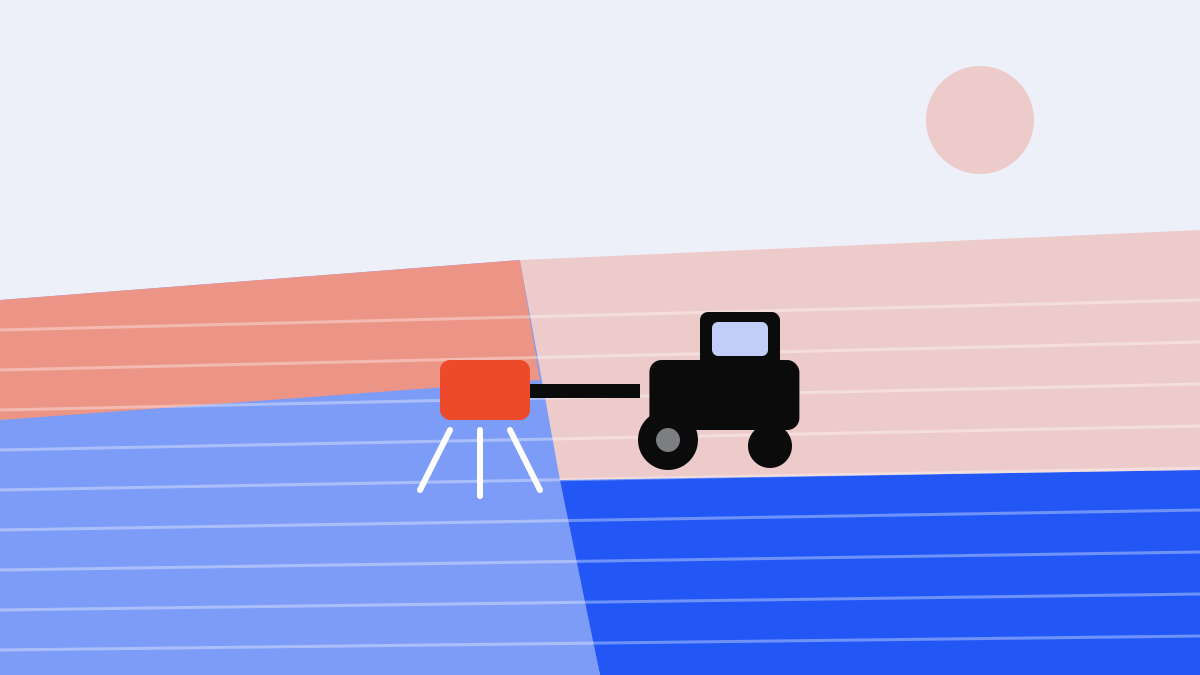
Every field is uneven. One corner holds water, a ridge dries out early, an old fence line has years of extra manure in it. Variable-rate application, usually shortened to VRA, is the practice of matching inputs to that unevenness: more seed or fertilizer where the ground can use it, less where it cannot.
The idea is old. What changed is that GPS guidance, cheaper sensors and controllers that talk to the implement have made it practical to do automatically, pass by pass.
How it works
A VRA system has three parts. First, a map of how the field varies, built from soil samples, past yield maps, satellite or drone imagery, or a mix. Second, a prescription that turns that map into a target rate for each zone. Third, a controller on the spreader, sprayer or planter that reads the tractor's position and changes the rate as it crosses from one zone into the next.
On modern equipment the tractor and implement usually share data over ISOBUS, the ISO 11783 standard for agricultural machinery. That is what lets a prescription file prepared on a laptop drive a spreader made by a different manufacturer than the tractor pulling it.
| Data source | What it tells you | Typical cost |
|---|---|---|
| Grid or zone soil sampling | Nutrient levels and pH, point by point | Per sample, repeated every few years |
| Yield maps | Where the crop actually performed | Free if your combine already records them |
| Satellite or drone imagery | Crop vigor during the season | Low per acre; needs interpretation |
| Electrical conductivity scans | Soil texture and water-holding differences | One-off survey per field |
When it pays and when it doesn't
VRA earns its keep in proportion to how variable a field really is. A uniform field gains little from a fancy prescription, while a field with sandy knolls and heavy hollows can show real savings on lime, phosphate or seed, and sometimes better yields in the zones that were under-fed before.
The map is the product. The spreader controller just reads it.
Farm size matters less than people assume. Contractors and co-operatives increasingly offer variable-rate spreading as a service, so a smaller farm can buy the prescription and the application without buying the equipment. The fixed cost that cannot be outsourced is good data about your own fields.
A sensible first step
Start with one input and one field you know is patchy. Lime is a common first choice because pH varies a lot, the payback is easy to see and an over-application is unlikely to do harm. Compare a season of variable-rate application with your usual flat rate on the same field, and keep the soil results. If the field does not vary much, you have learned that cheaply too.
About the author
Nkem Adeyemi
Nkem Adeyemi edits the medtech and agritech desks. A biomedical engineer by training, she worked in quality and regulatory roles at two device makers before moving into reporting, and grew up on a mixed farm that still argues about yield maps.
All stories by Nkem 3 stories
Keep reading
More from
the newsroom.




Liked this?
Get five more.
For founders, engineers and operators who would rather read the spec sheet than the press release.
The Town Crier Free
Your week in industry, in five minutes.
One email on Wednesday morning. The stories worth your time this week, and nothing else.
No spam. Unsubscribe anytime.