Depot charging or public fast charging: what a small delivery fleet should plan for.
The short version
- 01 Overnight dwell time makes depot charging the cheapest energy most fleets can buy.
- 02 Grid capacity and demand charges, not chargers, are the usual depot constraint.
- 03 Public fast charging is a backstop for long or irregular days, not a daily plan.
- 04 Talk to the utility before choosing how many chargers to install.
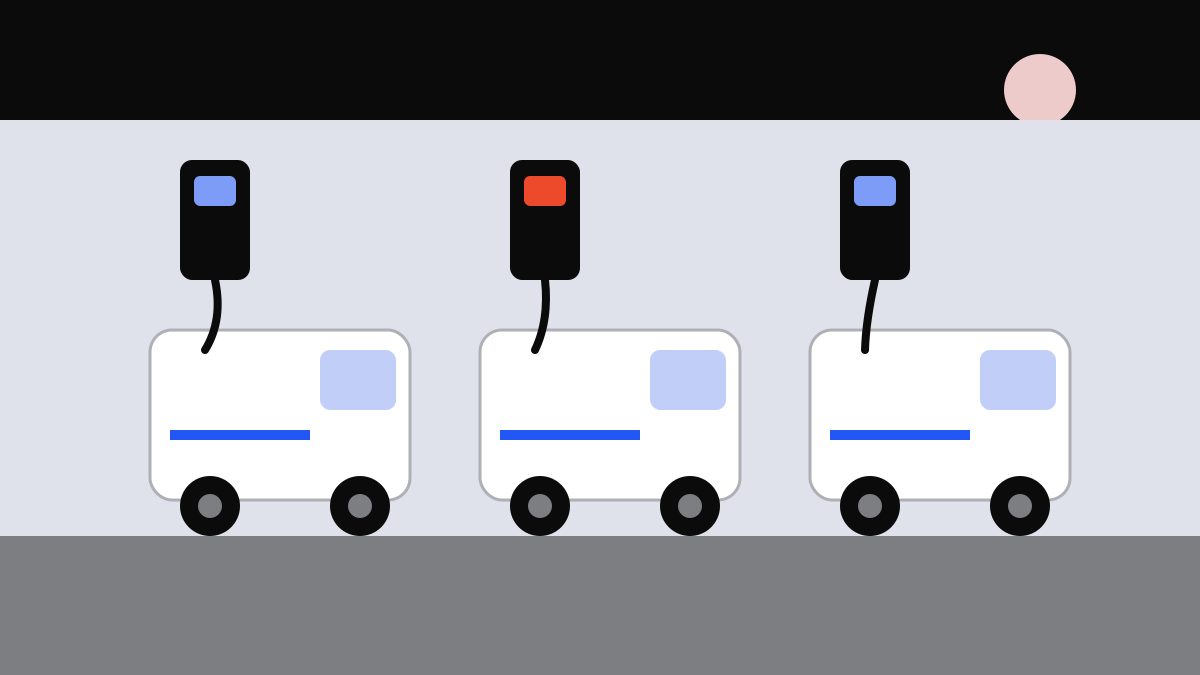
When a delivery business electrifies, the conversation usually starts with vehicles: range, payload, price. A few months in, the conversation that matters is about electricity. Where do the vans charge, when, at what price, and what happens on the day a route runs long?
Most small fleets end up with some mix of two answers: chargers at their own depot, and public fast chargers along the way. They suit different jobs, and getting the balance wrong is one of the quickest ways to lose the running-cost advantage that made electric vans attractive in the first place.
The two options side by side
| Depot charging | Public fast charging | |
|---|---|---|
| Typical power | AC chargers, usually around 7 to 22 kW per van | DC chargers, commonly 50 kW and up |
| Cost per kWh | Your commercial tariff; cheapest overnight | Usually several times the depot rate |
| Upfront cost | Chargers, installation and sometimes a grid upgrade | None for the fleet |
| Time cost | None if vans charge while parked overnight | Driver time waiting, plus detours |
| Best for | Predictable routes that return to base | Long or irregular days, and emergencies |
Why the depot usually wins
Delivery vans spend most nights parked at the same place for ten hours or more. That dwell time is the fleet's biggest asset. Even modest AC chargers can refill a typical urban route's worth of energy overnight, at the lowest rate on the bill and without anyone standing next to the van.
The catch is the connection. A row of chargers can add up to more power than an older building's supply can deliver, and some commercial tariffs add demand charges based on the highest load you draw in a month. Smart charging software that staggers sessions through the night often avoids both problems without new cables.
We planned for vans. We should have planned for the meter.
Where public charging earns its place
Public fast charging is the safety net. It covers the route that ran long, the van that missed its overnight charge and the occasional out-of-area job. Fleets that rely on it daily usually find the higher energy price and lost driver time eat into their savings quickly.
Ask your utility first
Before ordering chargers, ask the utility how much spare capacity the depot connection has and how long an upgrade would take. The answer shapes how many chargers you can install and how fast you can electrify.
The practical plan for most small fleets is simple: size depot charging to cover a normal day for every van, use software to keep the overnight load flat, and give drivers a public charging card for the exceptions.
About the author
Sam Osei
Sam Osei covers EVs and mobility. He came to journalism from fleet operations, where he planned the depot charging for a regional delivery business, and writes for the people who have to make the numbers work on a Monday morning.
All stories by Sam 2 stories
Keep reading
More from
the newsroom.


Liked this?
Get five more.
For founders, engineers and operators who would rather read the spec sheet than the press release.
The Town Crier Free
Your week in industry, in five minutes.
One email on Wednesday morning. The stories worth your time this week, and nothing else.
No spam. Unsubscribe anytime.